Cape Ann Granite: Building America's Cities
North Shore History, Cape Ann Granite, Rockport & Gloucester
Hammers, Stone, and Sea: How Cape Ann Granite Built America's Cities
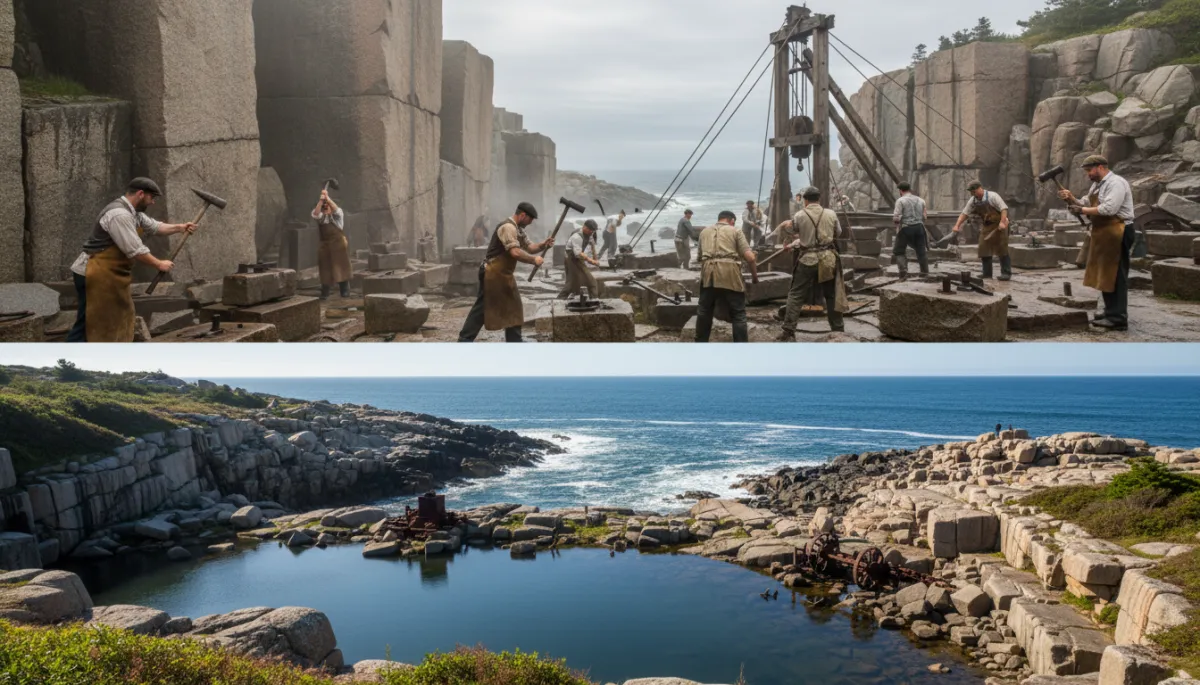
On a foggy morning in the 1850s, the quiet of Pigeon Cove in Rockport is broken by the sharp ring of iron on stone. Steam rises from the backs of men as they swing heavy hammers, the air filled with the smell of wet granite and salt. This was the daily soundtrack of Cape Ann granite history — a North Shore Massachusetts story that helped build America's growing cities from Charlestown to New York.
From Sandy Bay to Stone Empire: Where the Quarries Began
Long before Rockport was known for art galleries and harbor views, it was called Sandy Bay, a hard-working granite town at the far tip of Cape Ann Massachusetts. By the early 1800s, ship captains, builders, and engineers had discovered that the gray stone under Rockport and parts of Gloucester was dense, durable, and ideal for construction. Granite quarrying in Essex County began in small pits along the shore and quickly expanded inland as demand grew.
The heart of Rockport MA quarry history lies in three major areas: Pigeon Cove in northern Rockport, the dramatic Flat Ledge Quarry, and Gloucester's Babson Farm Quarry, now better known as the foundation of Halibut Point State Park Rockport. Together, these sites turned a quiet fishing peninsula into one of the most productive stone landscapes in New England and a defining chapter in Essex County history Massachusetts.
A Day in the Pit: A Quarryman Arrives in Pigeon Cove, 1853
Picture Patrick O'Shea, an Irish immigrant stepping off a wagon in Pigeon Cove Rockport in 1853. He has left famine and hardship behind, following rumors that the granite quarries of Cape Ann are hiring. Ahead of him, the ground opens into a broad stone amphitheater, walls of granite rising like a man-made cliff. Wooden derricks creak overhead, chains clanking as blocks of stone swing toward waiting carts.
Patrick joins a crew of Irish and Finnish laborers, the backbone of the quarry labor force. Together they drill holes by hand, drive wedges into seams, and coax massive blocks from the ledge. The work is punishing, but the wages are steadier than many other jobs available to new arrivals. In the evenings, Patrick returns to a crowded boarding house near the pit, where stew simmers on the stove and several languages mix around the table. These tight-knit boarding house communities stitched together the social fabric of granite quarrying Essex County in the 19th century.
Stone for Monuments, Sidewalks, and Cities
When we ask, where did the stone for Bunker Hill come from, the answer leads straight back to Cape Ann. The Bunker Hill Monument granite source was primarily the quarries of Rockport and Gloucester. Blocks cut from Flat Ledge and nearby pits traveled by schooner to Charlestown, where they were stacked into the towering obelisk that still dominates the skyline today. This connection has become a centerpiece of Cape Ann granite history and a point of pride in Rockport MA history and Gloucester MA history alike.
The stone did not stop at Charlestown. Cape Ann granite lined many Boston sidewalks, curbs, and civic buildings. It formed the foundations and street paving of New York City, disappearing beneath feet and carriage wheels but quietly supporting the growth of a metropolis. Post office buildings across New England, sea walls, and wharves all bear the signature of this hard, blue-gray stone. When people ask what was the Cape Ann granite industry, the answer is: a regional engine that quite literally underpinned 19th-century urban America.
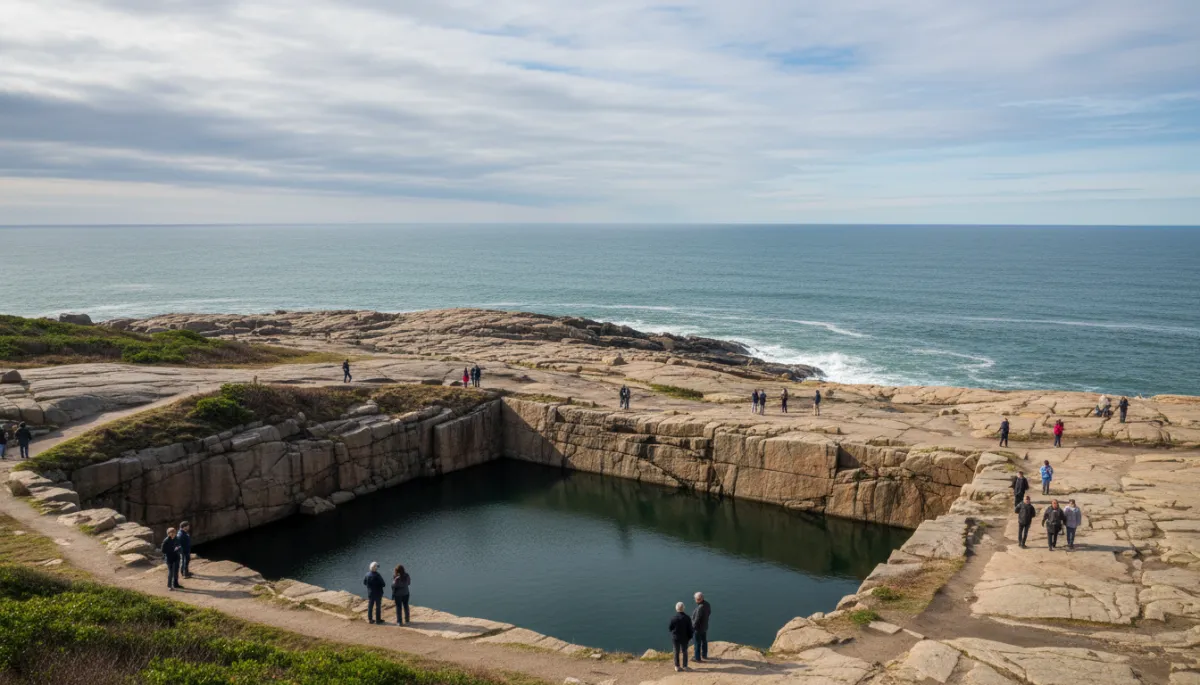
Halibut Point State Park lets visitors walk the rim of a former Cape Ann granite quarry.
Skilled Hands and Strong Communities
Beneath the roar of blasting powder and the grind of derricks, there was artistry. Stone cutters and polishers on Cape Ann were highly skilled craftsmen. Using chisels, templates, and an expert eye, they transformed rough blocks into paving stones, carved trim, and polished columns. Their work was in demand, and they earned good wages compared with many other trades in historic North Shore Massachusetts. In Rockport MA quarry history, these artisans stood alongside fishermen and shipbuilders as pillars of the local economy.
Finnish workers in particular became known for their precision and strength, while Irish crews were famous for their endurance and camaraderie. Together they built boarding house neighborhoods near Pigeon Cove, Babson Farm, and other pits. Children grew up with the distant thump of blasting as background noise. Churches, social halls, and small shops clustered around these enclaves, shaping a distinctive chapter of Essex County history Massachusetts that still echoes in family stories today.
Babson Farm Quarry and Halibut Point: From Industry to State Park
On the Gloucester–Rockport line, the Babson Farm Quarry once thundered with activity. Steam-powered derricks swung huge blocks toward waiting rail cars, and the ledge dropped deeper with each passing year. Today, that same site forms the centerpiece of Halibut Point State Park Rockport. Visitors walk along paths that trace the old cutting floors, peer down into the deep, water-filled quarry, and look out to the Atlantic where stone-laden schooners once sailed for Boston and New York.
The distinctive water-filled pits left behind by quarrying are now popular swimming holes and scenic landmarks across Cape Ann. At Halibut Point Rockport, interpretive signs explain the history of Rockport Massachusetts quarries, and some of the old quarry equipment still stands as silent witnesses. For anyone curious about can you visit old quarries in Massachusetts, this park offers one of the most vivid answers on the North Shore. It is also a favorite feature in local North Shore events and local life guides.
The Last Steam Derrick: A Quiet Ending in the Early 1900s
By the early 1900s, the world was changing. Concrete, steel, and new building methods began to replace heavy cut stone. The Cape Ann granite industry, which had peaked from the 1840s through the 1890s, found itself competing with faster, cheaper materials. Orders for big public works projects dwindled. Some quarries closed quickly; others hung on with smaller contracts for curbing and monuments.
Imagine one of the last days at a Pigeon Cove pit. The steam derrick coughs and hisses as the engineer throttles back for the final time. A handful of older quarrymen watch as the boiler cools, their faces lined from decades of sun and stone dust. They know that when the machinery falls silent, an era of Rockport MA history will close with it. Some workers drift into fishing or factory jobs; others move away. The pits slowly fill with rainwater, becoming unexpected ponds framed by raw granite walls.
From Granite Town to Art Colony
As quarry whistles faded, Rockport began to reinvent itself. In the early 20th century, painters and writers discovered the same dramatic coastline that once guided stone schooners. Studios and galleries appeared in former commercial buildings. The identity of Rockport shifted from granite to art colony, even as the old pits and stone walls remained in the background. This transformation is a favorite theme in North Shore neighborhood guides, where visitors and residents learn how industry gave way to creativity along the waterfront.
Q & A: Cape Ann Granite History and Today's North Shore
What was the Cape Ann granite industry in simple terms?
It was a 19th-century network of quarries in Rockport and Gloucester that extracted, cut, and shipped granite for monuments, sidewalks, wharves, and building foundations across New England and major cities like Boston and New York. It shaped both the economy and the landscape of historic North Shore Massachusetts.
Where did the stone for Bunker Hill come from?
Much of the granite for the Bunker Hill Monument in Charlestown was quarried from Rockport and Gloucester, including Flat Ledge and nearby Cape Ann sites. When you look up at that obelisk, you are seeing Rockport MA quarry history rising over Boston Harbor.
What happened to the Rockport granite quarries?
As concrete and steel became more common in the early 1900s, demand for cut granite declined. One by one, the quarries shut down. Many pits filled with water, machinery was removed or left to rust, and Rockport shifted its focus toward fishing, tourism, and the arts. The physical scars remain, now softened by trees and water.
Can you visit old quarries in Massachusetts on Cape Ann?
Yes. Halibut Point State Park Rockport, built around the former Babson Farm Quarry, is one of the best-preserved examples. Visitors can walk along granite ledges, view the water-filled pit, and read about the history of Rockport Massachusetts quarries. Other smaller, water-filled quarries appear on hiking trails and side roads throughout Cape Ann Massachusetts.
How does this history connect to the North Shore Massachusetts history we see today?
The granite blocks in harbor seawalls, the curbing along older streets, and even some front steps on historic homes all trace back to quarry days. Boarding house neighborhoods evolved into year-round communities, and many descendants of quarry families still live locally. Articles in the North Shore history collection often highlight how these stone foundations shaped present-day towns.
Why does Cape Ann granite history matter to residents and homeowners now?
Understanding granite quarrying Essex County adds depth to everyday places: a walk at Halibut Point, a drive past an old stone wall, or a stroll along a granite-lined sidewalk in Rockport or Gloucester. It connects modern life to the labor of immigrants and craftsmen who carved this landscape into something both useful and beautiful. For more context on how history shapes today's communities, the main site at essexcountyhomesforsale.com offers a wider look at local towns.
Final Thought: Stone Foundations of Today's North Shore
Walk the streets of Rockport or Gloucester and you can still feel the weight of this past underfoot. Granite steps leading to a front porch, a seawall holding back a winter storm, or a weathered block in a garden wall may have started life in the echoing pits of Pigeon Cove or Babson Farm. The story of Cape Ann granite history is not just about industry; it is about how stone, sea, and human determination shaped the character of the North Shore.
Today's neighborhoods, scenic parks, and harbor views rest on those foundations — literally and figuratively. The same cliffs and ledges that challenged quarrymen now inspire artists and hikers. The boarding house streets have evolved into residential blocks where families enjoy a coastal lifestyle layered over centuries of work and change. Exploring this history, whether on a trail at Halibut Point Rockport or through local stories and guides on North Shore history pages, reveals how deeply the granite era still lives within the landscape and identity of Cape Ann Massachusetts.
In the end, the ring of hammer on stone has faded, but the results remain all around us — in monuments, curbs, foundations, and the enduring sense that this is a place built to last. That is the legacy of Rockport MA quarry history and Gloucester MA history: a North Shore shaped by hammers, stone, and sea, still telling its story in every line of granite along the coast.


